
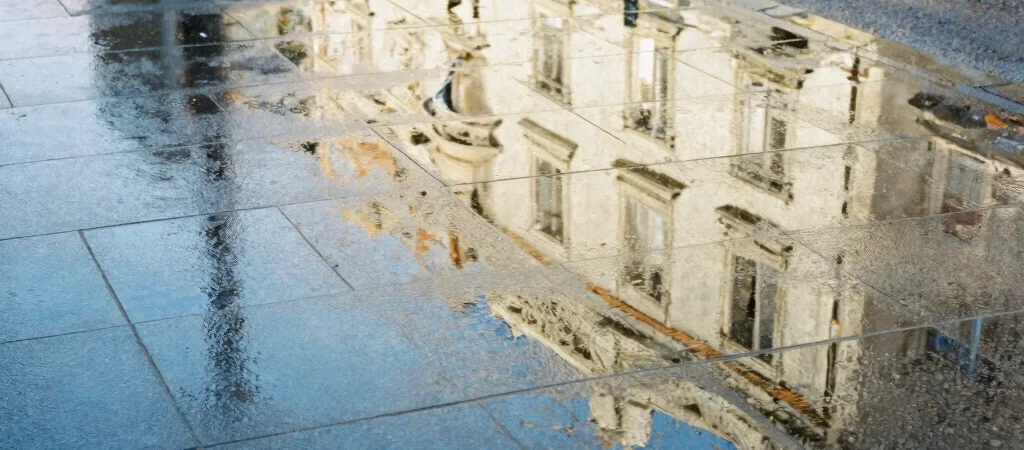
After rain, a street offers two pictures at once: the scene itself and its broken version in the pavement, glass, or polished metal. It is tempting to chase the brightest patch of reflected light, but brightness alone rarely says much about where you are. Look for a reflection that keeps a specific piece of the street in the frame.
Keep A Place In View
A shop sign, curb marking, transit shelter, or familiar roofline can anchor a layered composition. Move a step or two and watch how the reflected lines meet the real ones; a slight shift may separate a face from a window frame or bring a street corner into focus. The useful position is often lower than eye level, but check the ground before crouching on a busy sidewalk.
Focus is a choice, not a rule. A sharp reflection with a softer street behind it can emphasize texture, while keeping both layers legible gives more context. If autofocus keeps jumping between glass and the scene beyond it, place the focus point deliberately and take a moment to check the result.
Work With The Available Light
Cloudy daylight often softens contrast on wet pavement, while a bright window or vehicle display can become the strongest element in the frame. Expose for the detail you want to retain rather than assuming every highlight should be bright. On a phone or camera, review the image for clipped light areas and distracting edges before moving on.
A reflection photograph can become a decorative abstraction unless its caption restores some context. Record the neighborhood or street, the date, and what you were looking at; avoid naming private individuals or implying a scene tells more than it does. The strongest frame is not simply the most distorted one. It is the one that lets a viewer look twice and still recognize a place.